How WhaleClicks Competed Against Adobe and SemRush on a $70/Day Budget and Won
Key Takeaways
- WhaleClicks launched a Google Ads campaign in May 2026 targeting a keyword category that barely existed: AI GEO audits, with a $70/day budget and zero historical data.
- Over 26 active days, the campaign generated 17 conversions at a 7.66% conversion rate and a $9.02 average CPC.
- WhaleClicks achieved the highest impression share (23.81%) among all advertisers in the auction, outranking Adobe, SemRush, Jasper.ai, and Moz.
- The top-performing keyword, "geo audit," converted at 50%, a signal that high-intent, low-volume terms in new categories can punch well above their weight.
- The campaign was paused after identifying a lead quality problem, not a Google Ads problem, a distinction that shaped the strategy for the next campaign entirely.
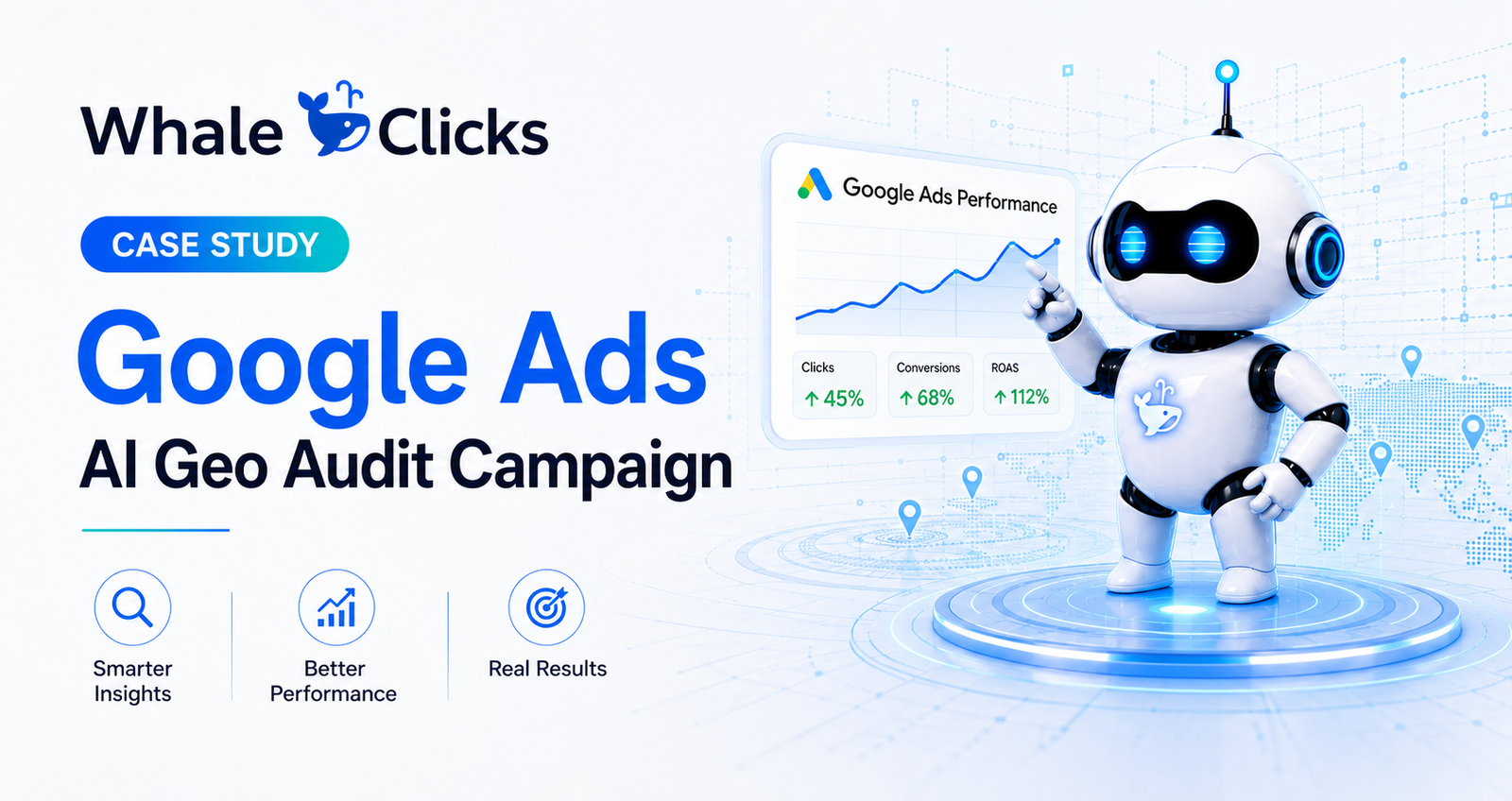
In May 2026, WhaleClicks launched a Google Ads Search campaign to test demand for a service that didn't have an established search market yet: AI Generative Engine Optimization (GEO) audits. There were no industry benchmarks, no keyword volume history, no competitor playbooks to borrow from. The category was being invented in real time.
What followed over 26 days was equal parts market discovery, performance experiment, and a hard lesson in offer positioning. This case study documents exactly what happened, what the data revealed, and how those findings now inform a sharper, better-targeted campaign.
The Starting Conditions
The campaign targeted California only, ran on a $70/day budget with a Maximize Clicks bidding strategy, the right call when you have no conversion history and need Google to learn fast. The service being advertised was a free AI GEO Audit: an analysis of how visible a business was inside AI-powered search results like ChatGPT, Perplexity, and Google's AI Overviews.
The keyword list was deliberately broad at launch, covering the emerging lexicon around AI search optimization: terms like "ai seo audit," "generative engine optimization," "geo audit," "llm visibility," and "ai search visibility." Some would prove to be gold. Others would drain budget without a single conversion. The work of the campaign was separating the two.
The Conversion Ramp-Up
New Google Ads campaigns in untested keyword categories don't perform at full speed on day one. Google's algorithm needs conversion signals before it can optimize delivery toward the right audience. The first week produced just one conversion. By week three, after the algorithm had accumulated real data, the campaign hit its peak of six conversions in a single week.
This ramp-up pattern is typical of new campaigns in emerging categories. The first two weeks are a discovery phase: Google tests delivery across a wide audience while you accumulate the conversion signals it needs to narrow its targeting. By week three, that targeting had tightened, and the conversion rate followed. The campaign went from one conversion in the first partial week to six in its best week, without any increase in budget.
Competing Against Companies with Unlimited Budgets
The auction insights data revealed something that initially seemed improbable. WhaleClicks, running a $70/day campaign targeting a niche AI audit service, achieved the highest impression share of any advertiser in the auction at 23.81%. Adobe, with its enterprise media budget, held 11.97%. SemRush, a category leader in SEO tools, held 15.80%. Moz, Jasper.ai, and a dozen other established platforms all came in below 10%.
The explanation is straightforward in hindsight: WhaleClicks was targeting the specific niche of AI GEO audits while the larger platforms were bidding across broader AI and SEO optimization terms. Precision beat budget. That 77.35% top-of-page rate, meaning nearly four out of every five times an ad was shown, it appeared above organic results, confirms that the Quality Score and targeting were working, not just the CPC bidding.
In an emerging keyword category, a tightly targeted $70/day campaign can outperform enterprise media budgets on impression share, because the competition is optimizing for reach while you're optimizing for relevance.
What Worked: The High-Intent Keywords
Not all keywords performed equally, and the performance gaps were striking. The most valuable keywords in a new category tend to be the most specific ones, terms that signal genuine purchase intent rather than research curiosity.
The pattern that emerged across all converting keywords was consistent: specificity correlated directly with conversion rate. "Geo audit" as a phrase match converted half the time at $17.13 per conversion. "AI SEO audit" converted at 22% at $46.51. These terms describe exactly what someone wants when they're ready to buy. Contrast that with "free ai seo audit", the campaign's highest-volume keyword at 57 clicks and a 14% CTR, but with a 8.77% conversion rate and $100.78 cost per conversion. The word "free" attracted exactly the audience it promised: people looking for free things.
What Didn't Work: The Budget Drains
Two keywords consumed a combined $521 in spend without producing a single conversion before being paused. "AI search optimization" (phrase match) attracted 45 clicks and $393.13 in spend across its run, the single largest spend line in the campaign, and converted zero times. "Geo optimization" added another $128 for 17 clicks and zero conversions.
The distinction between the "drains" and the "discovery" spend matters. The $521 spent on clearly non-converting keywords was waste that could have been avoided with better initial research. The $628 in discovery spend on keywords that showed impressions, some clicks, and some intent signals without converting, is the cost of operating in a category where no prior data exists. Both are recoverable lessons. The 40+ negative keywords added during the campaign's run are the direct product of those lessons.
By campaign end, more than 40 negative keywords had been added, covering job-seeker terms, competitor tool names, SEO software, academic research queries, and geographic modifiers. Each one represents a wasted click that, once identified, never happened again. A new campaign launching today inherits that entire filter list on day one.
The Real Problem: Lead Quality, Not Google Ads
The campaign generated 17 conversions. The pause decision wasn't about the numbers, it was about what those conversions represented. The highest-volume keyword, "free ai seo audit," attracted searchers who wanted a free tool, got the free audit, and didn't convert further into paid engagements. Conversion tracking recorded the form completion. Pipeline told a different story.
This is one of the most common misdiagnoses in digital advertising: attributing lead quality problems to the ad platform when the real issue is offer positioning. Google Ads did exactly what it was asked to do, it found people searching for a free AI SEO audit and delivered them to a landing page offering one. The gap was downstream. The offer was right for awareness; it wasn't right for monetization at the bottom of the funnel.
Pausing the campaign was the correct decision, and it was made sooner than most advertisers would have. Rather than continuing to spend $2,000/month on leads that weren't converting to revenue, WhaleClicks paused, analyzed, and redirected the strategy. The new Free Google Ads Audit campaign, with a tighter keyword list, a cleaner offer architecture, and a 40+ negative keyword head start, is the direct beneficiary of those 26 days of data.
What the Audience Data Revealed
The demographic and behavioral data confirmed that the campaign was reaching the right people in terms of profile, just not always the right people in terms of purchase intent. The core audience was 35–44 years old (31%), followed by 25–34 (26%) and 45–54 (21%). This is the typical B2B decision-maker demographic for digital marketing services. Desktop devices drove 56% of clicks against mobile's 43%, consistent with a business-hours professional audience. Peak impressions fell on Monday and Tuesday, the highest-intent days of the B2B buying week.
The audience was right. The keyword targeting for qualified buyers needed sharpening.
Five Lessons This Campaign Produced
1. New categories require runway. The algorithm needs 7–14 days of conversion data before optimization meaningfully improves. Campaigns in emerging keyword categories should be evaluated over 4–6 weeks, not 2.
2. "Free" in keywords doesn't mean low quality, but it needs management. "Free ai seo audit" drove the most conversions at the lowest CPC, but attracted the widest intent spectrum. It's a volume lever, not a quality lever. Use it with heavy negative keyword support and a landing page designed to self-qualify.
3. Impression share is a targeting problem, not a budget problem. WhaleClicks outranked Adobe and SemRush on a fraction of their budgets by targeting more precisely. The lesson for any campaign: before raising the budget, tighten the targeting.
4. The best keywords in a new category are often low-volume. "Geo audit" converted at 50% at $17.13 per conversion. It generated only two clicks. In a new category, low-volume exact-match terms that signal high purchase intent are worth far more than high-volume broad terms. Don't optimize for clicks, optimize for intent signals.
5. Pausing is a strategy, not a failure. The campaign was paused intentionally, with a clear diagnosis and a clear path forward. Every negative keyword, every performing keyword cluster, and every conversion data point carries forward into the next campaign. Twenty-six days of spend became a permanent performance foundation.
Are You Running Google Ads Without The Right Data?
Get a Free Google Ads Audit from WhaleClicks to learn where your budget is leaking, which keywords are quietly draining spend, and what the fastest path to better lead quality looks like, all reviewed by a senior strategist, no account access required.
Get My Free Google Ads Audit →Takes 30 seconds to request · No account access required