
AI Search Visibility · B2B SaaS Growth · GEO
Key Takeaways
- B2B buyers now use ChatGPT, Perplexity, and Google AI Overviews to find vendors, and most SaaS companies are invisible in those answers.
- GEO (Generative Engine Optimization) is the discipline of making your brand appear in AI-generated answers, not just Google’s link list.
- An AI GEO Audit diagnoses your current AI visibility across five dimensions: citation rate, content structure, authority signals, schema, and competitive gaps.
- B2B SaaS companies are the most exposed because their buyers are power AI users doing vendor research before a human ever picks up the phone.
- The window to establish AI visibility before competitors lock it in is narrow. The models being trained right now will influence buying decisions for years.
Picture this: As VP of Marketing at your 45-person B2B SaaS company you open ChatGPT and type: “What are the best pipeline analytics tools for early-stage startups?” Three of your competitors appear immediately, by name, with a clear explanation of what they do, who they serve, and why they’re worth evaluating. But your company is not mentioned once.
However, you do rank on page one of Google for that exact phrase, because you’ve been writing content about it for two years. You even have reviews on G2, and yet, when your most qualified prospects ask an AI to recommend a solution in your category, you don’t exist.
This is the new visibility gap, and it’s draining pipeline from B2B SaaS startups like yours across the USA right now while their marketing teams keep optimizing for a game that has fundamentally changed.
This is why smart VPs of Marketing at SaaS startups are running AI GEO audits to see where they stand on the types of queries their potential customers are entering on ChatGPT, Perplexity and even Google AI. But what exactly is an AI GEO Audit? What does it entail? And why is it that B2B SaaS companies put themselves at risk if they don’t start optimizing for AI searches before their competitors lock in the advantage.
The Shift From SEO to GEO: What’s Changed?
Traditional SEO (when done correctly) gets your website on a list of links served as search results. GEO gets your brand named in the answers themselves. That’s not a small distinction and it makes a huge difference between being discovered and being invisible.
For the last two decades, the traditional SEO game has been to write content and earn backlinks in order to rank on Google and get clicks (and hopefully customers). SEO was optimized for Google’s spiders, i.e., crawlers that indexed your website’s pages and ranked them ten links at a time. You competed to be at the top of that list (or you didn’t exist), because users pick from the top of the list only (no one bothers with page 2 on Google search results).
That model still works, but it’s no longer the whole game. B2B buyers are increasingly using AI tools as their first research touchpoint. According to a 2025 Salesforce State of Sales report, 65% of B2B buyers now use generative AI tools as part of their vendor research process. They’re not scrolling ten Google links. They’re asking a question to ChatGPT (or Perplexity) and reading a synthesized answer. And that answer either includes your company or it does not.
GEO: Generative Engine Optimization is the art of making your brand, content, and credibility easily legible to AI systems so they can cite your brand in their answers. GEO is the new SEO and unfortunately, most B2B SaaS marketing teams in the USA have not started doing it yet.

What Exactly Is an AI GEO Audit?
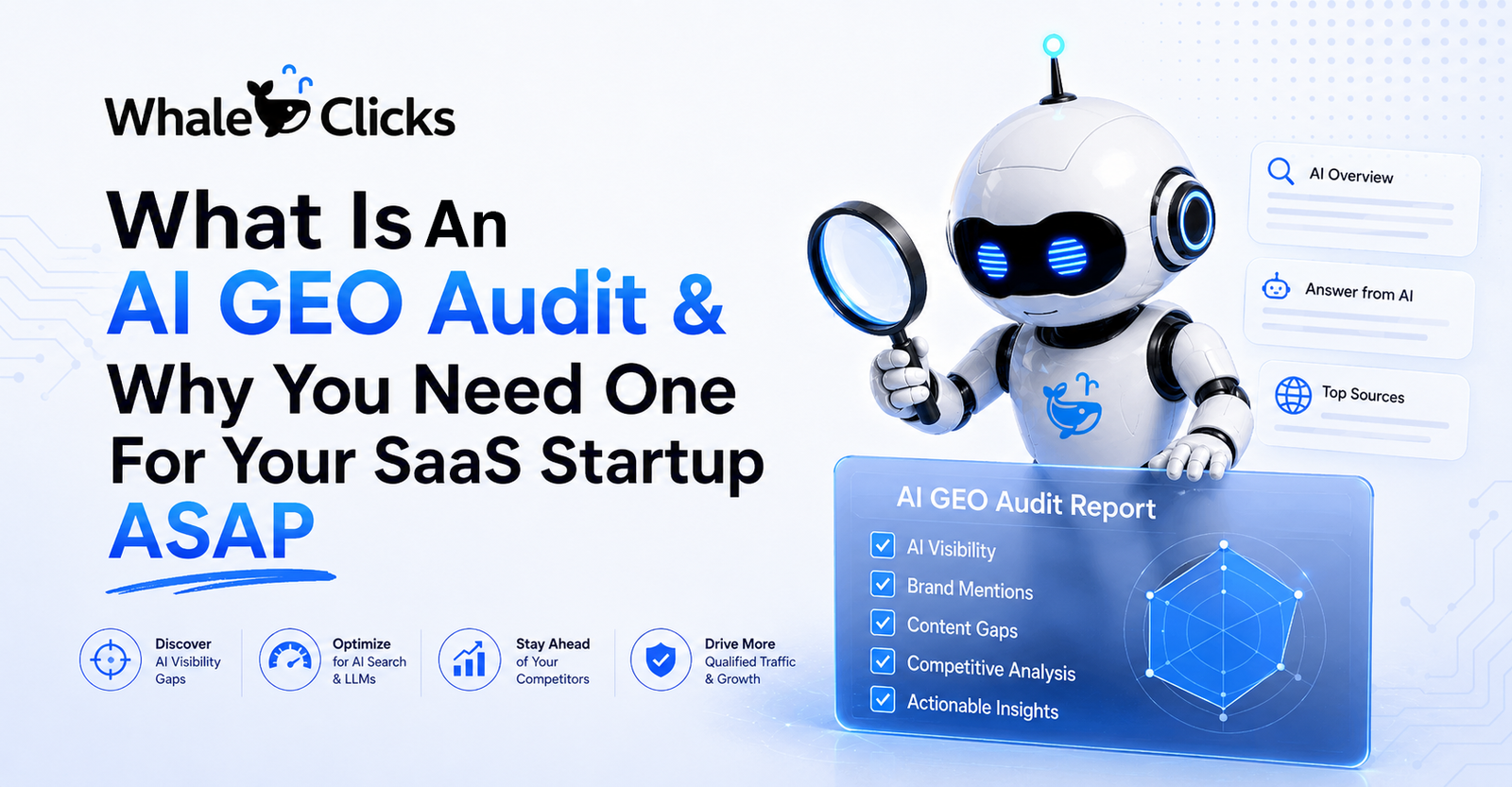
An AI GEO Audit is a diagnostic process. Think of it the way you think of a blood panel. Your doctor tells you what the results mean and what needs fixing first. A GEO Audit works the same way. It tells you exactly where your brand stands in AI search today and pinpoints the highest-priority gaps.
A thorough AI GEO Audit examines five dimensions:
-
AI Citation Analysis
Is your brand being named when AI tools answer questions relevant to your category? An AI GEO audit tests queries across ChatGPT, Perplexity, Claude, and Google AI Overviews using dozens of questions your buyers are actually asking. Most SaaS companies are shocked by what they find, or more accurately, by what they don’t find after performing an AI GEO audit.
-
Content Structure Assessment
AI models don’t rank pages. They synthesize them. So your content needs to be written in a way an AI can parse, understand, and confidently cite it. This means using clear definitions, direct answers, and a logical structure, no fluff. Historically, most SaaS content was written to rank on Google, not to be understood by a language model. Those are not the same thing.
-
Authority & Trust Signals
AI models are trained on the internet’s opinion of you. That means reviews, backlinks, third-party mentions, press coverage, and G2 / Capterra profiles. All this feeds into whether an AI considers your brand a credible source worth citing. An AI GEO audit checks your brand’s off-page authority profile specifically through the lens of what AI training data values.
-
Schema & Structured Data
This is the technical SEO foundation that most SaaS companies skip. Schema markup tells AI crawlers exactly what your organization does, who you serve, and what your content is about, in a machine-readable format. Without it, AI systems are guessing about your context. With it, you’re giving them a roadmap.
-
Competitive Visibility Gap
Which competitors are appearing in AI answers and where you are not? Which queries are your competitors owning that you’re absent from? Understanding the gap tells you exactly how fast you need to move and where to start.
An AI GEO Audit tells you exactly where your brand stands across all five of these dimensions, and what to fix first.
Traditional SEO vs. GEO: What Each Optimizes For
Understanding the shift from link lists to AI-synthesized answers
Why B2B SaaS Companies Are The Most Exposed To AI GEO
B2B SaaS buyers are technical, time-pressed, and deeply comfortable using AI tools. They are not only Googling, they’re also are asking ChatGPT to make shortlists for them.
Not every industry has the same AI search exposure. A local restaurant or a brick-and-mortar retailer faces a very different risk profile than a B2B SaaS company selling into the US tech market. Here’s why SaaS is uniquely vulnerable right now.
1. Longer Sales Cycles Mean More AI Research Touchpoints
A B2B SaaS deal with a $20K annual contact value (ACV) might involve six to twelve people, three demo calls, and a two-month evaluation process. Every one of those stakeholders is doing independent research, and AI tools are increasingly where that research starts. If your brand and services are invisible at the top of their research funnel, you’ll never make it onto their evaluation list and your sales team never gets a chance to pitch.
2. SaaS Category Language Moves Fast
AI models are trained on language. If your content was written two years ago and your category has evolved its vocabulary since, i.e., if your buyers now say “AI-native CRM” instead of “smart CRM,” for example, AI models won’t associate your older content with the current queries. This is a content freshness and terminology problem that most SaaS teams aren’t tracking. That’s why your technical SEO foundation needs to keep pace with how your category describes itself.
3. Your Competitors Are Already Moving
The SaaS companies investing in GEO right now are not doing it as a trend. They’re doing it because they understand that AI search visibility compounds the same way Google SEO did in 2008. Early movers establish authority. Late movers spend three times as much to catch up. The window to plant your flag in this space is right now, not after your next round of funding.
Five Signs Your SaaS Website Needs an AI GEO Audit
This list is designed to be self-diagnostic. If three or more of these apply to your company, you have a GEO visibility problem that is almost certainly already costing you pipeline.
You’re still getting organic traffic. Your keyword rankings haven’t moved much. But demo requests and inbound leads are softer than they were eighteen months ago. This is a classic early indicator that your buyers have shifted part of their discovery behavior to AI tools, and that your brand is not showing up there.
This is the fastest diagnostic you can run right now. Open ChatGPT and type: “What are the best [your category] tools for [your ICP]?” If your company doesn’t appear and three competitors do, you have a GEO visibility gap. This takes thirty seconds. Do it before you keep reading (use an incognito browser window).
Keyword-stuffed introductions, headers built for ranking algorithms, content that circles the point instead of answering it directly, these are symptoms of content written to rank on Google, not to inform AI queries. AI models prefer content that reads like a trusted expert wrote it for a real person. If your blog posts feel like they were written “for SEO,” they probably aren’t getting cited in AI answers.
Schema markup is the structured data layer that tells AI crawlers exactly what your organization does, who it serves, and what your content covers, all in machine-readable language. Without it, AI systems are making educated guesses about your brand. You can check your schema setup using Google’s Rich Results Test, or read our guide on setting up schema markup for B2B SaaS. Adding a missing schema is one of the fastest fixes with the highest GEO impact.
Your G2 profile, your Capterra listing, your mentions in industry publications, your backlink profile, this is the “internet’s opinion of you” that AI models are trained on. If those profiles are stale, incomplete, or underrepresented, AI systems have less evidence to cite you as a credible player in your category. A GEO Audit maps your entire off-page authority profile and tells you exactly where the gaps are.
Wondering Where You Stand Right Now?
We’ll audit your AI search visibility across ChatGPT, Perplexity, and Google AI Overviews and tell you exactly what’s missing, and what to fix first. The audit is free.
Get Your Free AI GEO Audit →What Happens If You Wait
AI search visibility compounds. The companies building it today will be the default recommendations for years. The companies waiting will spend three times as much to catch up, and some won’t be able to.
Here’s the uncomfortable reality about AI models: they are trained on historical data. The content that exists today, the brands that are being cited today, the authority signals that are accumulating today, these are feeding the training datasets that will power AI search responses for the next two to three years.
This is not like a Google algorithm update where everyone scrambles and adjusts in a few weeks. This is a slow accumulation of signals that rewards early movers and penalizes late ones with compounding disadvantage. Every week your brand doesn’t appear in AI answers for your category is a week your competitors are getting cited instead, and every citation they earn trains the AI models to recommend them next time.
The B2B SaaS companies that establish AI search visibility in 2026 will be the default recommendations when AI search behavior fully matures. If your category has ten serious players and three of them are already optimizing for GEO, the window for the remaining seven is closing right now, not at the end of the year.
The cost of waiting is not just missed traffic. It is missed pipeline, missed demos, missed deals, all from buyers who never knew you existed because the AI they trusted for a vendor shortlist didn’t include your brand.
What to Expect From an AI GEO Audit by WhaleClicks
WhaleClicks’ thorough AI GEO Audit delivers three things: your current AI citation rate across the platforms your buyers use, your top visibility gaps by query and competitor, and a prioritized action list you can start executing immediately.
WhaleClicks’ AI GEO Audit covers your full AI visibility footprint across ChatGPT, Perplexity, and Google AI Overviews. We test against the actual queries your ideal customers are asking, not generic category terms. We use the specific language B2B SaaS buyers in the USA are using when they’re evaluating solutions like yours. We then benchmark your brand against your direct competitors so you can see exactly where the gaps are and what you need to fix first.
The output is a clear picture of where your brand stands today in AI unbranded searches and an action plan organized by impact and effort: what to fix this week, what to build over the next 90 days, and what structural changes will compound your visibility over time. We also include a technical SEO foundation in our AI GEO sprint because GEO and technical SEO are deeply connected and a clean schema, fast load times, and well-structured content serve both disciplines simultaneously.
We’ve run this audit for B2B SaaS companies across a range of categories and the findings are almost always the same: A good Google presence, but minimal AI visibility. The gap between where most SaaS companies sit today and where they need to be is real, but it is also very fixable, especially for teams that move now.
Find Out Exactly Where Your SaaS Stands in AI Search
We audit B2B SaaS websites for AI search visibility, and right now the audit is free. You’ll get a clear picture of how your brand appears across ChatGPT, Perplexity, and Google AI Overviews, your top three competitive gaps, and a prioritized action list you can start executing immediately.
Get Your Free AI GEO Audit →Takes less than a minute to request. Results delivered within 24 hours right to your inbox. We also offer a free follow up call to discuss the findings and our top recommendations and fixes.