
HubSpot for SaaS Growth: The Complete Guide for B2B SaaS Companies in 2026
A practical, opinionated playbook for using HubSpot to connect marketing, sales, and revenue, written for SaaS founders, CMOs, and revenue leaders in the USA who are tired of duct-taped tech stacks.
B2B Brands Are Not Failing at Marketing. They're Failing at Plumbing.
Here's an uncomfortable truth most B2B SaaS founders in the USA need to hear before they burn another $200K on ads: your digital marketing isn't broken. Your digital marketing system is broken.
Here's the typical setup. You're running Google Ads, posting on LinkedIn, and paying a freelancer in a different time zone to write blogs. Your traffic has stayed steady and demos are getting booked. But every Monday morning at the leadership meeting, somebody asks the question nobody can answer: "Where are these leads actually coming from, and why aren't they closing?"
If that scene feels uncomfortably familiar, congratulations, you've discovered the silent killer of B2B SaaS growth. It isn't your ad copy or your pricing page. It's the duct-taped Frankenstein's monster of disconnected marketing and sales tools you're calling a "tech stack."
The good news: this is exactly the problem HubSpot was built to solve. But as great as HubSpot is for marketing and sales automation, it isn't plug-and-play. How you set it up and roll it out makes all the difference. So let's walk through how to implement HubSpot for your SaaS company without falling into the trap that kills 80% of HubSpot rollouts.
What Exactly Is HubSpot and Why Should B2B SaaS Brands Use It?
HubSpot is an all-in-one CRM platform that combines marketing automation, sales pipeline management, customer service, content management, and operations into a single system. For B2B SaaS companies in the USA, HubSpot is the fastest way to connect your marketing, sales, and customer journey into one growth engine, replacing fragmented tools while turning ad traffic into trackable revenue.
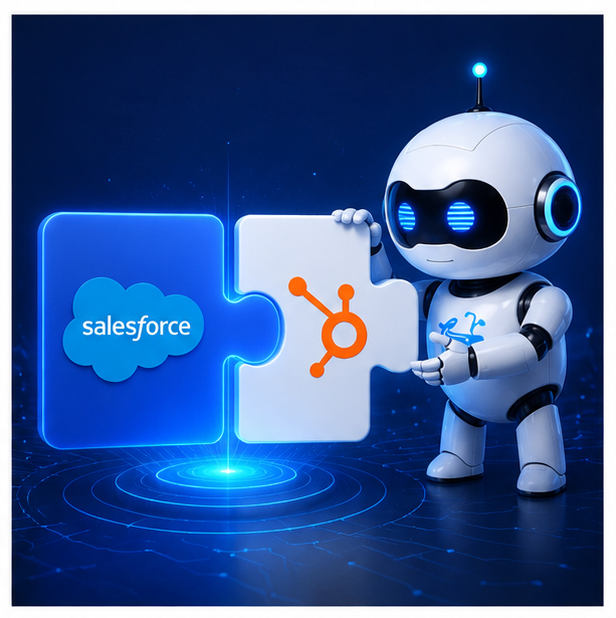
HubSpot is designed to scale with your growth, and it integrates natively with Salesforce. It also has its own sales hub that can stand in for Salesforce, but since most enterprise sales teams would give up their firstborn before they give up Salesforce, the good news is that HubSpot integrates cleanly with Salesforce and actually complements it.
The Real Problem B2B SaaS Companies Face
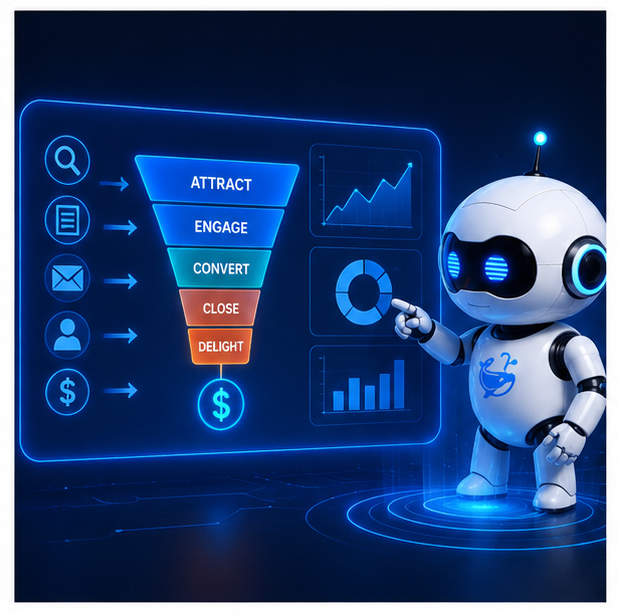
Picture a hypothetical Series A SaaS startup in Austin. Let's call them "Gridform." They sell a workflow automation tool. They've raised $12 million. They're spending around $80K a month on Google Ads, Meta Ads, and LinkedIn. They have a content marketer, a paid media specialist, and three sales reps.
Sounds healthy, right? Now look under the hood:
- Their ads point to a landing page hosted on Webflow.
- Their form submissions go to Zapier, which fires them into a Google Sheet that a sales rep checks twice a day.
- Email follow-up is sent manually through Gmail.
- Their CMO has a Looker dashboard pulling from five different sources, none of which agree on what a "qualified lead" is.
This is what a lot of B2B SaaS marketing/sales tech stacks look like in the USA right now. I know because I've worked with countless B2B SaaS startups, and they almost all neglect this part of their pipeline and then wonder why their sales are unpredictable or non-existent.
When your marketing and sales aren't connected, you don't just lose efficiency. You lose the ability to learn. You can't optimize which ads are working best because you can't trace a closed deal back to the campaign that generated it. It's like flying a 747 with the instrument panel covered in duct tape.
This is exactly where HubSpot makes a huge difference for B2B SaaS companies that implement it properly and use it as their sales, marketing, and content hub.
How Exactly Does HubSpot Help B2B SaaS Companies?
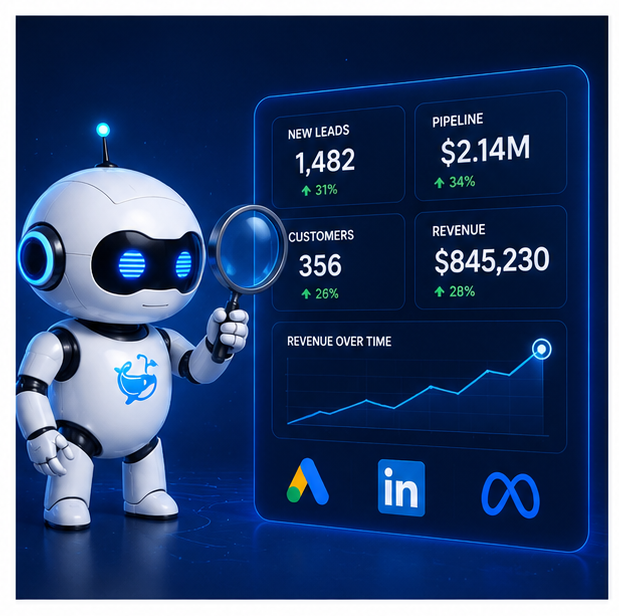
HubSpot helps B2B SaaS companies by unifying marketing, sales, and customer data into a single source of truth, enabling end-to-end attribution from first ad click to closed revenue. When implemented correctly, every visitor, lead, and paying customer lives in one place, and you can pull up any record to see exactly how that customer arrived, what content they consumed, and which campaign generated the deal.
You can't think of HubSpot as just a CRM. When configured properly, HubSpot becomes a growth system that unifies marketing, sales, and customer success operations. Every click, every form fill, every email opened, every demo booked, and every closed deal lives in the same database.
Why HubSpot Is Perfect for B2B SaaS (Especially in the USA)
Most SaaS companies don't fail because the product is bad. They fail because their funnel is fragmented, their data is incomplete, and marketing and sales operate like two divorced parents pretending to be civil at a wedding. HubSpot fixes all three.
1. HubSpot Connects Marketing to Revenue (Not Just Leads)
Tracking lead generation is important, but tracking leads alone without tying them to revenue is a vanity metric. Revenue is the metric that matters. Once HubSpot is properly configured, you can trace the exact path your customer took: which Google Ad keyword brought the lead, which landing page converted them, which email got them to book a demo, which sales rep closed the deal, and how much MRR they're worth nine months later.
For SaaS marketing strategy in the USA, where customer acquisition cost (CAC) efficiency is the difference between a Series B and a mass layoff, this level of attribution isn't optional. It's existential.
2. HubSpot Turns Your Content Into a Growth Engine
When you write a blog post inside a properly configured HubSpot, you're not just creating a one-time piece. That blog becomes a lead generator (with native CTAs and forms) and a segmentation trigger (you'll know which blogs your visitors read). This is especially powerful for SaaS SEO, and it's quickly becoming critical for AI search optimization, what we call GEO (Generative Engine Optimization). Because ChatGPT, Perplexity, and Google AI Overviews favor well-structured, trustworthy content, HubSpot makes structuring your content frictionless while keeping track of who reads it and when.
3. HubSpot Aligns Sales and Marketing (Finally)
Marketing generates demand. Sales closes it. In the wild, those two teams usually communicate through Slack passive-aggression. But with HubSpot, sales sees the full lead history (which blogs the lead read, which ad they clicked, when they last opened an email). Marketing sees the revenue impact of every campaign. Leadership sees the entire marketing-and-sales funnel as one continuous flow instead of disconnected dashboards.
How HubSpot Powers the SaaS Customer Journey (Step by Step)
Let's walk through what this looks like in practice, because "alignment" is just a buzzword until you can see it make money.
-
Traffic
Marketing drives traffic via Google Ads, Meta Ads, LinkedIn, SEO blogs, and increasingly, AI search visibility. Every channel is tracked in HubSpot via UTMs and source attribution.
-
Conversions
A visitor lands on your HubSpot landing page (or your website with an embedded HubSpot form). The submission flows directly into HubSpot, and into Salesforce if integrated. Zero manual syncing, zero Zapier-induced anxiety, zero leads lost to a typo in a Google Sheet.
-
Nurturing
This is where most SaaS companies in the USA bleed pipeline. HubSpot solves this by enabling automated email sequences, lead scoring, and behavioral segmentations. For example, if a user dowloads a how-to guide, he gets one nurture sequence and a status update from cold to qualified. A pricing-page visitor who opens three emails gets a different sequence, and your sales team gets a "Hot lead, call now" notification. This is not magic, it's just plumbing done right.
-
Sales Pipeline
Reps open a deal record in HubSpot (or Salesforce when integrated) and see everything: the original ad, pages visited, emails opened, resources downloaded. No more cold outreach. Every call starts with context. Sales cycles get shorter because reps stop wasting the first ten minutes asking what the prospect already knows.
-
Retention & Expansion
HubSpot doesn't stop at closed-won. It supports onboarding workflows, upsell tracking, and customer lifecycle management. Companies like Notion, Airtable, and Monday.com have proven that expansion revenue is where SaaS unit economics actually become profitable, and you can't drive expansion without data.
HubSpot vs Salesforce: Which Is Better for B2B SaaS Companies?
For B2B SaaS startups between seed and Series B, HubSpot is the better choice because it deploys in 2 to 6 weeks, integrates marketing and sales natively, and costs significantly less than Salesforce. Salesforce is the better choice once you scale past 200 employees or operate a large enterprise outbound sales motion.
Salesforce: Powerful, But Brings Its Own Implementation Consultant
Salesforce is enterprise-grade. It's deeply customizable and used by basically every Fortune 500 company in the USA, from Coca-Cola to American Express. It can do almost anything, if you have the time, money, and patience to configure it.
The downsides are equally well-known. Salesforce is expensive, requires heavy setup (and usually a $200/hour admin who speaks in acronyms nobody else understands), and historically separates marketing from sales, meaning you'll need Pardot, Marketing Cloud, or another bolt-on, all of which require additional licenses, additional consultants, and additional Tylenol. For a 200-person enterprise sales org, Salesforce is unbeatable. For a 12-person SaaS startup trying to hit $5M ARR, it's overkill that will slow you down.
HubSpot Sales Hub: Simpler, Faster, More Aligned
HubSpot Sales Hub is easier to implement (we've shipped working pipelines in two weeks for clients), marketing-native by design, and faster to scale. For most B2B SaaS companies in the USA between seed and Series B, HubSpot gets you to revenue faster, full stop.
HubSpot Sales Hub vs Salesforce: Side-by-Side Comparison
How the two stack up for B2B SaaS companies in 2026
| Factor | Salesforce | HubSpot Sales Hub |
|---|---|---|
| Best fit for | Enterprise (500+ employees) | Startups & mid-market SaaS |
| Setup time | 3 to 9 months | 2 to 6 weeks |
| Marketing integration | Requires bolt-ons (Pardot/MC) | Native |
| Total cost (year one) | $$$$ | $$ |
| Learning curve | Steep | Manageable |
| Reporting | Powerful but complex | Strong out of the box |
| Implementation cost | $25K to $100K+ | $5K to $20K typical |
| Best for SaaS at | Series C and beyond | Seed through Series B |
The Smart Move: Start With HubSpot, Add Salesforce When You're Ready
HubSpot is one-stop shopping with native marketing and sales hubs. If you're a startup that can't afford Salesforce yet, HubSpot is the perfect all-in-one solution. You can always add Salesforce later, but most teams that start with HubSpot for marketing and sales tend to enjoy the native integration so much that they don't bother. Either way, you can use HubSpot for marketing automation and inbound, then Salesforce for enterprise sales operations once you've moved upmarket. The two integrate cleanly when set up by someone who knows what they're doing (which is literally what we do at WhaleClicks).
Why Most HubSpot Implementations Fail (Don't Be This Company)
Here's the part nobody wants to admit. HubSpot doesn't fail. Bad implementation does. We see it constantly: a SaaS company signs up for HubSpot, an internal generalist gets handed the keys, and twelve months later the platform is being used as a glorified contact list while the team complains it "isn't worth the price."
The most common mistakes we see:
- No clear funnel strategy or defined customer journey
- No lead scoring or lifecycle stages
- No integration with paid ads platforms
- No alignment between marketing metrics and sales metrics
- No ownership, just a generalist tinkering between other priorities
What works is the opposite: a clear SaaS funnel mapped end to end, deep integration with your website (or your website running natively on HubSpot) and ad accounts (you can run ads directly inside HubSpot too), all your analytics flowing in, and ruthless alignment between marketing campaigns and sales pipeline.
How WhaleClicks Helps SaaS Companies Win With HubSpot
Most agencies install HubSpot, set up three workflows, send you a 47-page PDF, and disappear. That's not what we do. At WhaleClicks, we operate as your Fractional CMO, meaning we don't just install tools, we build the strategy and the system that makes those tools generate revenue.
A typical WhaleClicks HubSpot + SaaS engagement includes:
Connecting HubSpot to Your Website
Form embeds, tracking pixels, behavior triggers, and conversion events wired in cleanly so every visitor session feeds the CRM. You can also run your entire website (and blog) natively in HubSpot.
Building Your CRM the Right Way
Pipelines that match your actual sales team, lifecycle stages your team will actually use, and deal tracking that reflects how revenue is actually achieved at your company.
Aligning Marketing With Sales
Ad campaign tracking, multi-touch attribution, and conversion optimization across your sales funnels so you stop arguing in meetings about what counts as a Marketing Qualified Lead.
Integrating With Salesforce When Needed
If you're moving upmarket and your enterprise sales team is on Salesforce, the answer is a clean integration where HubSpot owns the top of the funnel and Salesforce owns the enterprise sales execution.
This is part of our Fractional CMO service for SaaS companies in the USA. Combined with our HubSpot Marketing Automation Service, it's the difference between owning a HubSpot license and building a growth engine.
HubSpot + SEO + GEO: Why It's Different in 2026
Here's where it gets interesting. AI search is rewriting the rules. Platforms like ChatGPT, Perplexity, Claude, and Google AI Overviews are how B2B buyers in the USA now discover SaaS solutions. They don't browse the top ten Google links anymore, they ask AI a question and get a synthesized answer.
This is why you need GEO (Generative Engine Optimization), the next evolution of SEO. HubSpot makes you ready for it because your content is structured, your data is connected, and your funnel is trackable. When an AI cites your blog as the answer to "best CRM for B2B SaaS in the USA," HubSpot is what captures the traffic from that citation and turns it into pipeline. It can even track the keyword that generated that lead.
Frequently Asked Questions: HubSpot for SaaS Companies
QIs HubSpot good for SaaS companies?
Yes, HubSpot is one of the best CRMs for SaaS companies, particularly B2B SaaS startups in the USA scaling from seed through Series B. It connects marketing, sales, and customer data into a single system, eliminating the fragmented tech stacks that kill pipeline visibility.
QHow long does HubSpot onboarding take for a SaaS company?
HubSpot onboarding typically takes 2 to 6 weeks for SaaS companies, depending on complexity, integrations, and how clearly the funnel is defined. Implementations done by experienced HubSpot agencies (like WhaleClicks) tend to ship faster because the strategy is built before configuration starts.
QIs HubSpot better than Salesforce for SaaS startups?
Yes, for most SaaS startups HubSpot is better than Salesforce. HubSpot is faster to deploy (2 to 6 weeks vs 3 to 9 months), easier for non-technical teams, and natively integrates marketing with sales. Salesforce becomes more relevant once you're operating at enterprise scale or running a large outbound sales team.
QCan HubSpot integrate with Salesforce?
Yes, HubSpot integrates natively with Salesforce. Many growing SaaS companies use HubSpot for marketing automation and inbound, and Salesforce for advanced enterprise sales operations. The native integration is solid when configured by someone who understands both systems.
QWhat is the best CRM for B2B SaaS in the USA?
HubSpot is one of the top CRMs for B2B SaaS companies in the USA due to its ease of use, scalability, marketing-native integration, and strong reporting. Larger enterprise SaaS companies often run a hybrid setup using HubSpot for marketing and Salesforce for sales execution.
QHow much does HubSpot cost for a SaaS company?
HubSpot for most growing B2B SaaS companies costs between $1,200 and $3,500 per month, typically using the Marketing Hub Professional + Sales Hub Professional bundle. Pricing scales with contact volume and feature needs. Implementation costs typically run $5K to $20K when handled by a specialized agency.
QDoes HubSpot support attribution tracking for paid ads?
Yes, HubSpot supports multi-touch attribution across Google Ads, Meta Ads, LinkedIn Ads, and other paid channels. This makes it ideal for SaaS companies that need to tie ad spend directly to closed revenue and MRR.
QWhat is GEO (Generative Engine Optimization)?
GEO, or Generative Engine Optimization, is the practice of structuring web content so it gets cited by AI search engines like ChatGPT, Perplexity, Claude, and Google AI Overviews. HubSpot supports GEO because it produces clean, structured content with consistent metadata, which AI engines prefer when delivering answers to user queries.
Ready to Build a Real Growth System for Your B2B SaaS Startup?
If you want to implement HubSpot the right way, connect it to your website, align it with your ads and SEO, and build a real growth engine, WhaleClicks can help. We deliver the strategy, the implementation, and the ongoing optimization that turns HubSpot from just a tool into a revenue machine.
Book a Free Strategy Call →