
And Why It May Be the Smartest Move Your B2B SaaS Startup Makes This Year.
By Max Milano | Tech Writer
Last year, a B2B SaaS founder came to us at WhaleClicks with what he believed was a marketing problem. He had closed his first angel round, hired his first sales rep, and built a product his early users genuinely liked. His website was pulling in traffic. Demo requests trickled in weekly.
But his sales pipeline would not grow.
So, he did what founders do: he threw resources at the problem.
First came a freelance performance marketer sourced from Upwork. He was expensive and confident, but his results could not be linked to any meaningful revenue movement. Then came an SEO agency. Then, a content writer who talked a lot about ‘growth hacks.’ After six months and a significant portion of his runway, the company’s revenue was almost exactly where it had started.
The founder was not short on effort. He was not short on tools. What he was short on was strategic architecture, I.E., a coherent system designed around one goal: filling his sales pipeline with qualified buyers who actually needed his product.
Digital marketing rarely fails due to a lack of effort. It fails because there is no unified strategy that aligns all tactics toward the same target: revenue.
What this founder ran into is a trap that catches hundreds of SaaS companies every year. And it is precisely the problem that fractional digital marketing was built to solve.
The Quiet Rise of Fractional Digital Marketing
Get Digital Marketing Leadership Without the Full-Time Price Tag
The concept of fractional digital marketing is straightforward. Rather than hiring a full-time senior marketing leader and constructing an entire department around them, a company brings in a team of experienced marketing professionals on a part-time or retainer basis.
These professionals may operate as fractional CMOs, Heads of Growth, or channel-specific strategists. They take ownership of the go-to-market strategy, guide execution across channels including SEO, content, demand generation, and lifecycle marketing, and then adjust the system as results come in.
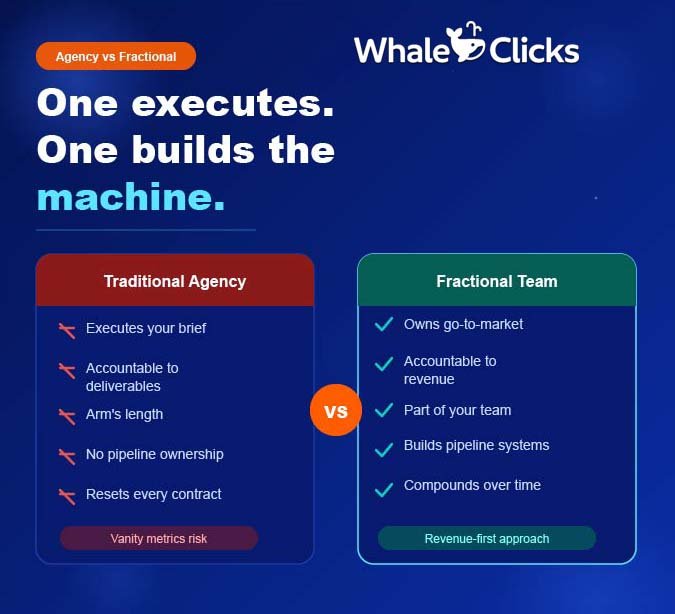
The key distinction between fractional marketing and a traditional agency relationship is strategic ownership. An agency executes campaigns. A fractional marketing team designs the machine that campaigns run on, and is accountable to the same pipeline targets your sales team cares about.
For early-stage B2B SaaS companies, that difference is not a subtle one. It often determines whether marketing spending compounds into pipeline growth or disappears into vanity metrics.
Why Modern SaaS Marketing Has Become So Complicated
There was a time when B2B SaaS growth looked relatively simple. You launched a product, ran some ads, published a few blog posts, and converted the resulting leads into paying customers.
That model no longer reflects reality.
Modern SaaS marketing is a multi-layered system in which every component affects the others. SEO feeds demand generation. Product positioning shapes conversion rates. Onboarding experiences determine whether customers stay or churn. Paid acquisition is only profitable when the landing pages it drives traffic to are properly optimized. Content only drives pipeline when it is built around the specific queries your ideal buyers are using at the specific moment they´re ready to evaluate solutions.
When one of these systems is broken or missing, the others underperform. You can spend tens of thousands on Google Ads and watch your budget drain because the landing page does not match buyer intent. You can publish content for six months and generate zero pipeline because the topics you chose do not map to purchase decisions.
Despite this interconnected reality, most early-stage SaaS companies approach marketing as a sequence of isolated experiments. They launch a blog. Wait. Try Google Ads. Wait. Install a marketing automation tool. Wait some more. Each tactic is evaluated in isolation, disconnected from the broader system it should be feeding.
Without a strategic architecture holding these pieces together, your marketing budget is not an investment. It is an expense.
Fractional marketing addresses this by introducing senior strategic thinking before the tool stack and tactic list begin to expand. The goal is to establish what your go-to-market system actually needs to look like, then build towards it deliberately, rather than assembling scattered components and hoping they eventually cohere.
The Early Hiring Trap Most SaaS Companies Fall Into
When a SaaS company begins to grow, hiring a Chief Marketing Officer seems like the obvious next move. Marketing needs direction. Direction requires experience. Experience requires investment. The logic is clean.
The reality is messier.
A CMO hired into an early-stage company frequently inherits a situation that makes success extremely difficult. Product-market fit may still be in flux. The ideal customer profile (ICP) has probably not been rigorously defined. The sales motion is still being tested. The budget is constrained, and the data available for decision-making is limited.
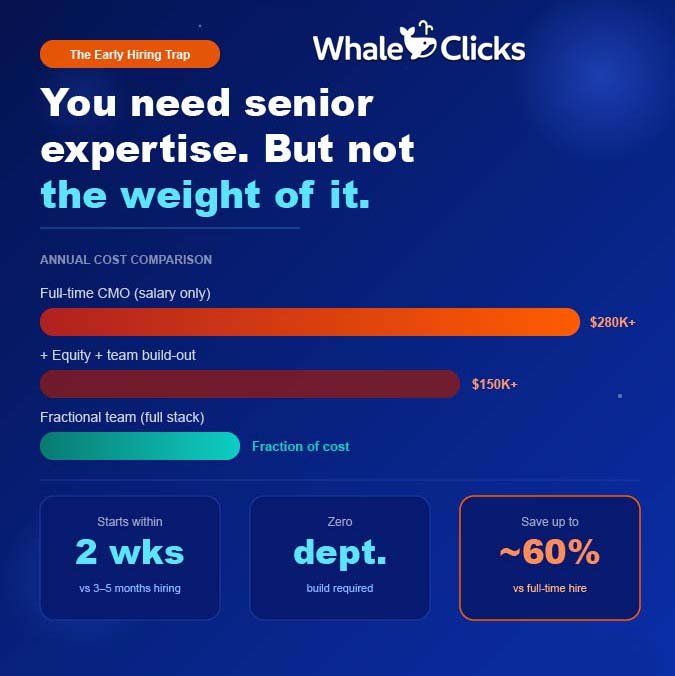
Under these conditions, even an excellent marketing executive will struggle to demonstrate the kind of impact that justifies their cost and organizational weight. And the cost is high. A mid-level CMO in a major market commands a base salary between $180,000 and $280,000, before equity, benefits, and the team they will inevitably need to hire to work beneath them.
This creates a genuine paradox for early-stage companies. They need senior marketing expertise, but they are not yet in a position to support the organizational structure that senior marketing talent requires to operate effectively.
Fractional leadership breaks this deadlock. The company gains experienced strategic direction at a fraction of the fully loaded cost, without prematurely building departmental infrastructure around a hire who may not fit the company’s needs six months from now.
It is not a compromise. It is the correct response to uncertainty.
How Fractional Marketing Teams Are Actually Structured
The most effective fractional marketing models follow a recognizable pattern.
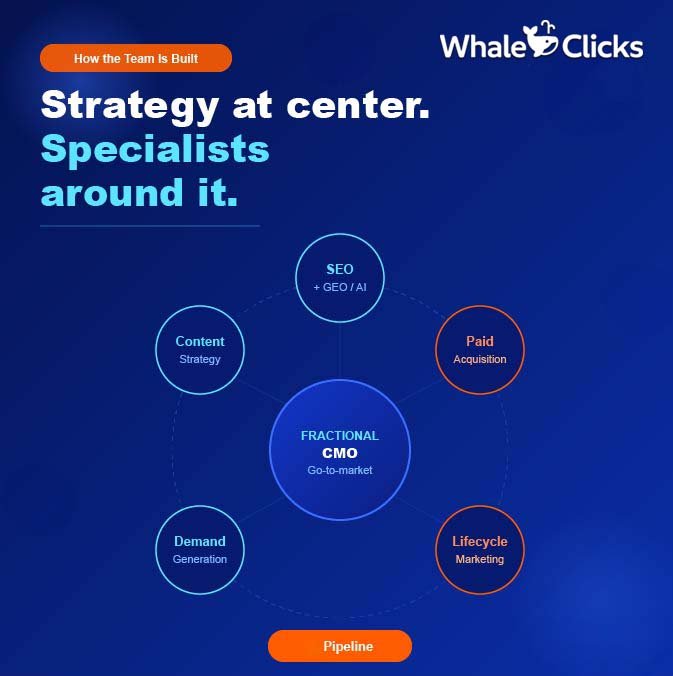
At the center is a senior strategic leader, typically a fractional CMO or Head of Growth, who owns the go-to-market strategy. This person defines the company’s positioning, sets channel priorities, establishes pipeline targets, and determines how resources should be allocated across the marketing system. They are accountable to revenue outcomes, not to content calendars.
Around this strategic core sits a network of channel specialists: SEO and search experts, content strategists, demand generation professionals, and lifecycle marketers, each contributing expertise within their defined domain. Crucially, these specialists do not operate independently. Their work is coordinated by the central strategy, which means each piece reinforces the others rather than running in parallel without connection.
Think of it as the difference between a collection of solo performers and a well-rehearsed ensemble. The individual musicians may be equally talented, but only the ensemble produces something coherent.
This structure also means that the team composition can evolve as the company’s needs change. Entering a new vertical? Add a specialist with relevant experience. Shifting from content-led inbound to paid acquisition? Adjust resource allocation without restructuring your entire marketing operation.
The best fractional teams function like a growth operating system, strategic at the center, modular at the edges, and always calibrated around your pipeline.
The Concrete Advantages of Going Fractional
Speed to Market
Recruiting senior marketing talent is slow. Sourcing candidates, running interview cycles, negotiating offers, and waiting out notice periods can consume three to five months. During that time, competitors are moving, and growth targets are slipping.
Fractional teams, by contrast, typically begin work within two to three weeks. These are operators who have already solved the problems your company faces in dozens of previous engagements. They do not need six months to develop an opinion about your positioning or your ideal customer profile (ICP).
Senior Expertise Without Organizational Weight
Full-time executives come with a structure attached. They need direct reports, budget authority, internal systems, and regular management attention. A fractional leader brings expertise without the infrastructure, keeping the company lean at a stage when being lean is an advantage.
This matters not just financially, but operationally. Every new layer of organizational complexity adds friction. Fractional engagement introduces capability without adding that friction.
Adaptability as the Market Shifts
SaaS markets evolve quickly. New competitors emerge. Channels that worked six months ago become saturated. Buyer behavior shifts in response to economic conditions or new tools entering the market. A rigid in-house team, optimized for the company’s needs at one point in time, can become a liability when the environment changes.
Fractional models adapt naturally. Expertise can be brought in or shifted as circumstances require. This elasticity is difficult to replicate with a fixed headcount.
The Outside Perspective
Internal teams become fluent in their own narrative. Assumptions harden into facts. Messaging that felt sharp two years ago remains unchanged because no one inside the company has a reason to question it.
Fractional leaders arrive without that accumulated baggage. They have seen the same patterns, the overly broad ICP, the positioning that tries to appeal to everyone, the misalignment between what marketing promises and what the product delivers across many companies and many growth stages. What looks invisible from the inside often becomes obvious from the outside within the first few weeks.
Sometimes, the most valuable thing an experienced outsider provides is not a new tactic. It is the permission to stop doing something that has never worked.
What Fractional Marketing Is Not
Because the term is used loosely, it is worth being precise about what fractional marketing does not mean.
It is not a freelancer hired to execute specific deliverables. A content writer producing blog posts on a monthly retainer is not fractional marketing. They are an outsourced resource performing a defined task without ownership of strategy or outcomes.
It is not a traditional agency relationship. Agencies typically operate at arm’s length, optimizing for the deliverables specified in their scope of work. Fractional teams operate as an extension of your company, with accountability to the same business outcomes your leadership team cares about.
And it is not a temporary fix for a company in distress. The fractional model works best when it is chosen deliberately as the appropriate structure for the company’s current stage, rather than as a fallback after full-time hiring has already failed.
The distinction matters because companies that confuse fractional marketing with cheaper execution often apply it incorrectly. They hire a fractional leader but then expect them to operate like an agency, producing deliverables without the strategic authority to make the decisions those deliverables depend on. That arrangement usually fails, and the failure is attributed to the model rather than to its misapplication.
The Revenue Connection: What Good Fractional Marketing Actually Produces
Strategy without measurable output is just theory. The legitimate test of a fractional marketing engagement is whether it produces a pipeline.
In practice, the early deliverables of an effective fractional engagement tend to look like this: a clearly defined ICP built on data rather than assumptions; a positioning statement that speaks to specific buyer pain points rather than generic value propositions; an audit of existing channels identifying where budget is being wasted and where there is untapped opportunity; and a prioritized 90-day roadmap with explicit pipeline targets attached.
From that foundation, execution follows in a structured sequence rather than as scattered experiments. The channels activated are those most likely to reach the specific buyers the company is targeting, with messaging calibrated to the problems those buyers are trying to solve.
The result, when the model is implemented correctly, is not just more marketing activity. It is a system that compounds. Content produces organic search traffic that converts into leads months after it was published. SEO visibility built in quarter one generates inbound pipeline in quarters three and four. Lifecycle sequences turn trial users into paying customers at a higher rate. Each piece reinforces the next.
This compounding effect is the central reason fractional marketing, done well, produces better long-term ROI than most paid acquisition strategies, which reset to zero the moment you stop spending.
Why the Fractional Model Is Becoming the Default for Growth-Stage SaaS
The broader shift toward fractional marketing reflects a larger change in how sophisticated SaaS companies think about building their operations.
The previous generation’s playbook emphasized scale through headcount. Grow fast, hire aggressively, and build a large internal team that owns every function. That approach made sense in a low-interest-rate environment where growth was the only metric that mattered, and capital was cheap enough to fund the burn.
The current environment rewards a different set of priorities. Efficient growth, strong unit economics, and the ability to demonstrate a credible path to profitability matter more than raw expansion. Companies are being asked to do more with leaner teams, which means the premium on high-quality expertise, rather than large quantities of junior execution, has increased.
Fractional marketing fits this model precisely. It delivers senior expertise calibrated to the company’s actual stage and needs, without the overhead of building and maintaining a full internal department that the company may not yet be able to use effectively.
WhaleClicks Digital Marketing In-A-Box: Your Complete Growth Engine, Ready to Deploy
WhaleClicks was built specifically for B2B and SaaS companies that need a complete, senior-led marketing operation without the time, cost, or risk of building one from scratch. We call it Digital Marketing In-A-Box, and the name is intentional. You are not buying a service. You are getting a fully integrated growth system.
Here is what that means in practice:
From day one, you have access to a senior fractional marketing strategist who owns your go-to-market approach and is accountable to your pipeline targets, not your content calendar or your impression counts. They are supported by a team of specialists in SEO, GEO (Generative Engine Optimization for AI-driven search), search-driven demand generation, and conversion optimization, all operating as a coordinated unit rather than independent contributors.
Our core focus is search: capturing the exact moments when your ideal buyers are actively looking for solutions like yours, on Google, on AI platforms, and across the channels where B2B purchase decisions are actually being made. We build the inbound system that puts your solution in front of the right buyers with the right message at the right time, and we continuously refine it based on the data.
The system we build compounds over time. Traffic, rankings, and pipeline visibility continue to generate returns over time. That compounding effect is the core reason our clients treat WhaleClicks as a long-term growth partner rather than a monthly retainer they evaluate quarter to quarter.
We offer three clearly structured engagement tiers designed around where your company is right now. Whether you are a founder who needs to validate your first inbound channel, a growth-stage company ready to build a full demand engine, or a scaling SaaS business looking to dominate search in your category, there is a model built for your stage. No vague deliverables. No six-month lock-in before you see what you are getting.
The B2B SaaS founder from the opening of this piece eventually stopped burning through his marketing budget. His pipeline grew. His cost per demo dropped. And his sales team, for the first time, had more qualified conversations booked than they could handle. None of that required a CMO hire or a larger team. It required a system.
If you are ready to build yours, you know where to find us.