
By Max Milano (Tech Writer)
You’ve invested heavily in content for your B2B SaaS startup. Your WordPress website looks the part, you’ve spent real money building out your SEO tech stack, and been publishing consistently. And yet your pipeline from organic search is either flat or impossible to attribute to anything specific.
That is a frustrating place to be. And it is more common than most SaaS founders and B2B marketing leaders want to admit.
Here is what nobody is telling you: the problem is not your content, it’s that search engines and AI systems cannot properly interpret what your website actually does, who it serves, or why it should be trusted. They are guessing. And when algorithms guess, they guess conservatively, which means your competitors with cleaner technical SEO foundations are getting the visibility you have been working toward.
This is one of the first things a good fractional CMO will flag in a technical audit. Not because schema markup is some obscure SEO trick, but because it is the kind of foundational fix that often gets overlooked yet can quietly unlock everything you´ve already built content-wise. It’s also the kind of work that rarely gets done unless someone senior is looking at the full picture, because it lives in the gap between content strategy and technical SEO, and most teams are not sure who owns it.
So let’s fix it. This guide walks through exactly how to implement schema markup using Rank Math on WordPress (step by step, no developer needed) and how a fractional CMO uses it as part of a broader strategy to make your B2B SaaS website genuinely competitive in both organic search and AI-generated results.

What Schema Markup Actually Does (And Why It Should Matter To You Right Now)
Schema is structured data embedded in your website’s code. Its purpose is precision: it tells search engines and AI systems not just what your content says, but what your content is.
That distinction matters more than most B2B marketers realize.
When Google reads a blog post, it can infer meaning through keywords and context. But when Google reads a blog post with properly implemented schema, it knows definitively whether that page is an article, a service description, a how-to guide, or an FAQ. That clarity allows it to match your page more confidently to high-intent queries, and these are the kind of searches that signal a buyer is at the bottom of the funnel.
For SaaS companies and B2B brands, this is especially critical. You are not chasing volume. You are chasing qualified intent. Schema is one of the clearest signals you can send to help search engines connect your expertise to the right audience at the right moment.
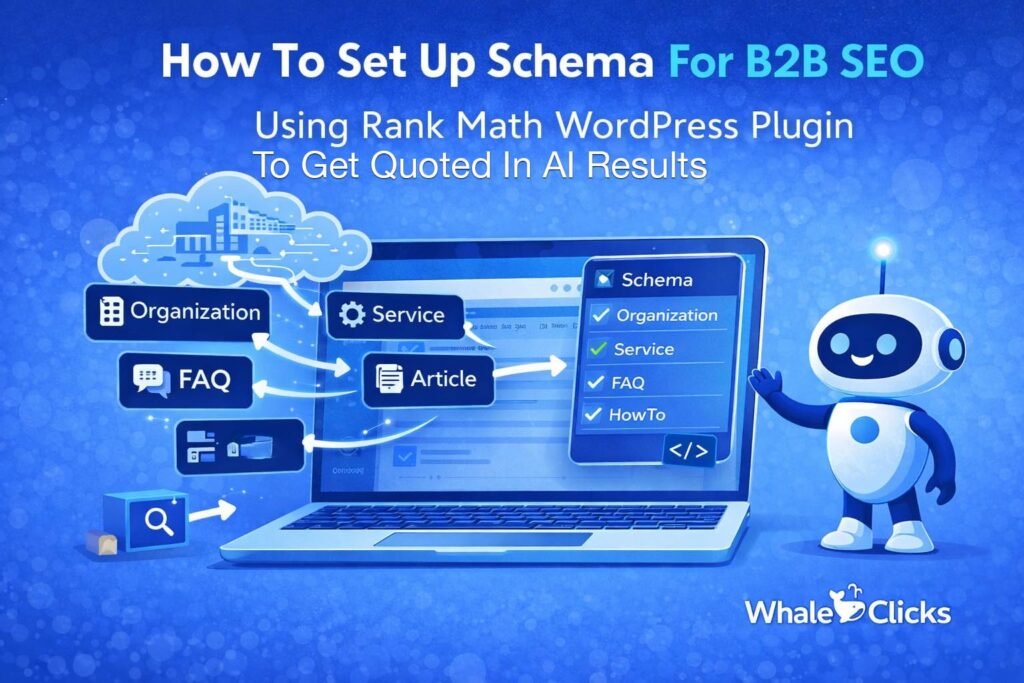
There is also an AI generative search layer to consider. AI engines like ChatGPT and Google’s AI Overviews extract structured meaning when composing responses. They look for definitions, step-based logic, question-answer pairs, and clear authority signals. Schema markup is exactly the kind of structural clarity that reduces friction for those systems. That intersection of schema and AI discoverability is what the industry is now calling GSO or “Generative Search Optimization”, and it is becoming a core component of any serious SEO tech stack.
Quickguide
How to · Rank Math + WordPress · No developer needed
Set up schema to get quoted in AI results
Four steps to make your B2B content machine-readable for search engines and AI systems.
Identify AI-driven buyer questions
Find the exact questions your buyers type into ChatGPT and Google AI before they reach your site. These become the content you structure with schema.
Customize Rank Math schema by page intent
Add FAQ and HowTo schema blocks
Use the Rank Math FAQ block for every Q&A section on the page
Apply HowTo schema to procedural guides. One schema entry per step
Rank Math generates JSON-LD automatically in the background. No code required
Structured Q&A and step-based content is what AI engines extract and cite
Validate and test every page
Run both checks every time a page goes live or gets a major update. Unresolved errors actively confuse search engines.
How to Implement Schema Markup Using Rank Math on WordPress (Step by Step, No Developer Needed)
Step 1: Identify the AI-Driven Questions Your Buyers Are Already Asking
Before you touch a single schema setting in Rank Math, you need to know which questions your content should be answering, specifically, the questions buyers are typing into AI systems.
This is where most B2B schema strategies fall apart before they even begin. Teams jump straight to implementation without mapping intent. The result is a correctly formatted schema wrapping the wrong content.
Start by thinking like your buyer at the moment of discovery. What are they asking ChatGPT, Perplexity, or Google’s AI Overviews before they ever reach your website? In the B2B SaaS world, those questions might sound like: “What is server-side tracking, and why does it matter?” Or, How do I lower customer acquisition cost in B2B SaaS? Or What is the best CRM for a SaaS company at Series A?
These are not just keyword research prompts. They are content architecture signals. Every AI-driven question your buyer asks represents a page you should have, formatted in a way that schema can label and structured in a way that AI systems can extract.
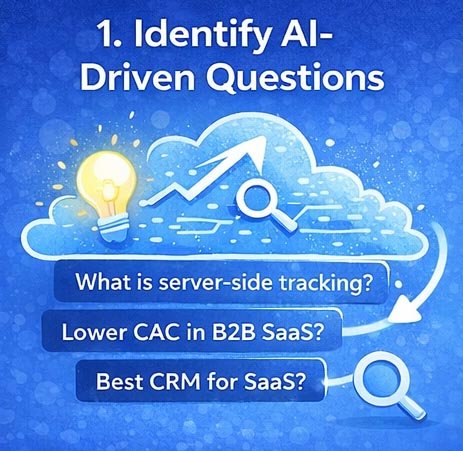
Here is the practical process. Pull your Google Search Console data and identify the queries where you have impressions but low or zero clicks. These are questions you are showing up for but not winning. Layer in competitive gap analysis using tools like Semrush or Ahrefs to find the questions your competitors are ranking for. Then cross-reference both lists with the types of questions that appear in AI-generated answers in your niche.
What you will end up with is a prioritized list of buyer questions that represent both SEO and GSO opportunities. That list becomes the foundation for your schema implementation. Every FAQ block, every How-to guide, every service page, all of it flows from understanding these questions first.
Step 2: Customize Rank Math Schema (Default Settings Are Not Enough)
If you have Rank Math installed on your WordPress site, schema is already being generated automatically. Your homepage uses Organization schema. Your blog posts use Article schema. Your service pages use WebPage schema.
That is a useful baseline. But it is generic, and generic schema is the lowest bar.
Generic schema tells search engines what type of page exists. It does not communicate what expertise you deliver, what problems you solve, or what structured knowledge you offer. If every blog post on your site is simply labeled “Article,” you are treating a technical SEO deep dive and a company news update as the same kind of content. That is not a signal, that’s noise.
To improve AI visibility, qualify for enhanced search result types, and strengthen your technical SEO foundation, you need to intentionally customize your schema.
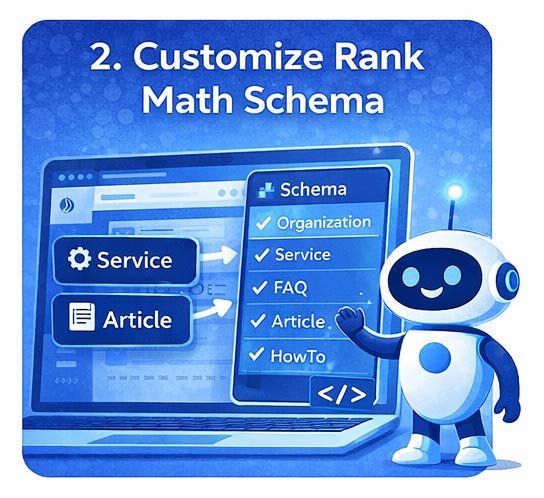
Open the page you want to optimize in your WordPress editor. Scroll down to the Rank Math panel and click the Schema tab. From there, access the Schema Generator. This is where intentional decisions begin to matter.
Match schema type to page intent. Your homepage should use Organization schema, and you should populate it fully with your company name, logo, social profiles, and contact details. This is foundational for entity recognition.
Service pages describing for example PPC management, technical SEO, or HubSpot automation services should use Service schema, not the default WebPage schema. The more specific the label, the more accurately search engines can categorize what you offer.
Step-by-step instructional content, like a guide on implementing server-side tracking or building an SEO software stack, should use Howto schema. This signals that the content is procedural, which aligns directly with how AI systems generate instructional responses.
Any page with clear question-and-answer sections should use FAQ schema. If your content addresses common buyer objections, then Q&A formatting with FAQ schema makes that content dramatically more extractable by AI engines.
Long-form thought leadership and insight-driven articles should be labeled as Article schema. Rank Math generates the appropriate JSON-LD automatically in the background, no code required, but the intentional selection is yours to make.
Step 3: Add FAQ and Howto Schema (The GSO Opportunity Most B2B Teams Miss)
This is where the real competitive gap lives because most B2B websites publish solid content and then leave it as unstructured prose. They miss the opportunity to tell AI engines exactly what type of content they are presenting.
When an AI system scans the web looking for an answer to a question like for example “how does fractional marketing support fast-growing SaaS companies” (a real query appearing in WhaleClicks’ own search impression data) its actively looking for structured question-and-answer content. FAQ schema creates a direct signal that your content contains that format.
For example, when someone asks ChatGPT or Perplexity how to build a tech stack for SEO, they are looking for step-based, instructional content. A Howto schema labels that type of content as exactly that.
In Rank Math, adding FAQ schema is straightforward. Use the FAQ block in your WordPress editor for any question-and-answer section on your website or add it directly through the Schema Generator if you are working on existing content. Each question and its corresponding answer gets its own structured entry, and that structure is what AI systems can parse cleanly.
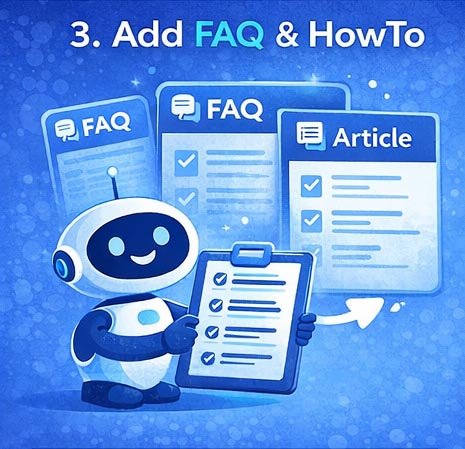
For Howto schema, the same principle applies. Each step in your instructional content should be clearly delineated in the schema, with a concise description of what the step accomplishes. If you are for example explaining how to implement Google Tag Manager, how to structure a B2B Google Ads budget, or how to audit a technical SEO setup using free tools, Howto schema tells AI systems that your content is authoritative and procedural, and this is exactly the format they favor when constructing instructional responses.
This is not theoretical. It’s a structural alignment between the format of your content and the format that AI systems prefer to extract and reference. Schema markup does not guarantee a citation, but it significantly reduces the friction that prevents it.
How Schema Helps Your Content Get Quoted in AI Results
AI engines like ChatGPT, Perplexity, Claude, and Google’s AI Overviews do not simply index your content the way traditional search engines do. They synthesize it. When a user asks a question, these AI systems scan available sources, evaluate their structure and authority, extract the most relevant and clearly formatted information, and compose a response, often without the user ever clicking through to the original source.
That means being quoted in an AI result is a form of visibility that exists above and beyond traditional rankings. And schema markup is one of the most direct structural signals you can use to increase the likelihood of it happening.
When AI systems evaluate content sources to answer a specific question, they favor pages that exhibit three things: clear topical authority, structured formatting, and low interpretive friction. Schema markup directly addresses all three.
FAQ schema tells an AI system that your page contains explicit question-and-answer pairs, exactly the format an AI needs to extract a clean, citable answer. If a buyer asks ChatGPT “what does a fractional CMO do for a SaaS startup?” and your page has a properly structured FAQ block with that exact question labeled in schema, you have removed every barrier between the AI and your answer.
Howto schema signals that your content is step-based and instructional, the format AI systems default to when constructing procedural responses. If you have written a guide on server-side tracking implementation and wrapped it in Howto schema, you’re not just ranking for that keyword, you’re competing to be the source the AI cites when someone asks it the question.
Article schema with proper authorship signals helps establish your content as a credible, attributable source and this matters when AI systems are evaluating whether to reference your page or move to one with clearer authority signals.
The practical steps are straightforward. Audit your most important pages for AI-driven questions you’ve identified in Step 1. Ensure every question-and-answer section has an FAQ schema. Ensure that every instructional guide has a Howto schema. Populate Article schema with author credentials and publication dates. Then validate everything through Google’s Rich Results Test and Schema.org’s validator.
Then go a step further. Write content that directly and explicitly answers the questions your buyers are typing into AI systems. Structure those answers in the first paragraph, not buried on page two. Use clear, declarative language. Avoid unnecessary hedging. AI systems extract confident, well-structured answers, and schema tells them your content has one.
This is GSO in its most practical form. Not a theoretical concept. These are a set of structural decisions you can make today that compound over time as AI-driven discovery becomes the dominant channel for B2B buyer research.
Step 4: Always Validate and Test Your Schema
After updating schema on any page, verification is non-negotiable.
Use Google’s Rich Results Test at search.google.com/test/rich-results and enter your URL. This confirms whether your structured data qualifies for enhanced result types in Google Search; things like rich snippets, FAQ dropdowns in the SERP, and structured listings that stand out visually from standard blue links.
Then run your URL through validator.schema.org. This checks for syntax errors and structural issues in your markup. If warnings or errors appear, resolve them before moving on.

Technical SEO is not about assumption; it’s about confirmation. A schema implementation with unresolved errors is not just neutral. It can actively confuse search engines and undermine the clarity you are trying to create. Validation is the final quality check that ensures everything you have built is working as intended.
Build validation into your publishing workflow. Every time a new page goes live, or a significant content update is made, run both checks. It takes five minutes and protects everything else you have invested in the page.
The Full B2B Schema Game Plan
If you are starting from scratch or auditing an existing site, here’s a sequence that makes sense.
Begin with question mapping. Identify the AI-driven buyer questions that represent your highest opportunities. Check your homepage and ensure its Organization schema is fully populated. Tackle your service pages next and replace any generic WebPage schema with a Service schema. Then audit your blog content systematically, adding FAQ schema wherever question-and-answer content exists and converting procedural guides to Howto schema. Validate everything at each stage. Then strengthen internal linking between authoritative pages to reinforce the topical structure that schema is helping to define.
This is how you build machine clarity. Schema is not a trick. It’s infrastructure, the same way your HubSpot workflows are infrastructure, the same way your Google Tag Manager implementation is infrastructure. It does not produce results in isolation, but without it, everything else is operating at a disadvantage.
This Is Where a Fractional CMO Makes a Real Difference
Most B2B marketing teams know they need better SEO. They have the content. They have the tools. But what they often lack is the strategic architecture that connects technical decisions (like schema implementation) to revenue outcomes.
That is exactly what a fractional CMO provides.
At WhaleClicks, we work with B2B SaaS startups as a fractional digital marketing agency, bringing senior marketing leadership without the full-time executive overhead. Our fractional CMO service is built for founders and leadership teams who need someone to own the strategy, manage the technical SEO foundations, align the HubSpot automation stack, and drive demand, not just advise on it.
We do not just optimize content, we optimize architecture, Schema alignment and GSO readiness for AI-driven discovery. We lay down the technical foundation that can determine whether your brand shows up in organic searches, in structured results, and in AI-generated answers.
If you are a B2B SaaS startup investing in marketing but not yet seeing the qualified pipeline to match, that gap usually lives in your infrastructure, not the budget.
Let’s build it properly. Explore WhaleClicks’ Fractional CMO Service →