
By Max Milano (Tech Writer)
We’ve all been there, whether as an in-house PPC manager or an agency representative speaking to new customers. You finish your Google Ads PPC strategy presentation, the powers that be and/or the client nod along, and then the devastating question lands: “So, we were thinking we could start Google Ads with a budget of twenty dollars per day.”
This question is delivered with the quiet hope that this small daily budget will somehow unlock a predictable stream of qualified leads and new customers. It rarely does.
The obsession with daily budgets is one of the biggest mental traps in B2B Google Ads. It feels practical. It feels safe. It feels controllable. But it is the wrong way to think about paid search. Daily budgets do not drive pipeline. Cost per acquisition does. Customer lifetime value does. Revenue does.
If you want Google Ads to become a predictable pipeline engine instead of a slow drip of random leads, you need to shift the conversation ASAP from daily spend to economics. But how do you do that? How do you explain to the powers that be, succinctly and clearly, the best way to set realistic Google Ads budgets?
You must first set the ground straight: the real optimization targets in Google Ads are CPA and CAC, not daily spend. But how can you get a quick and realistic estimate of how much you need to spend to be competitive in Google Ads in your sector? Simple. You need to start in Google Keyword Planner.
Google Keyword Planner: The Reality Check Most B2B Teams Need
Many B2B and SaaS search campaigns share similar characteristics: relatively low search volume, high cost per click, and a long sales cycle. But the deal value is often huge.
This is why your B2B Google Ads campaigns don’t need micro budgets. They need data.
Typical B2B SaaS and industrial CPC ranges in the United States make the problem even clearer. In the US market, high-intent B2B keywords typically cost between $5 and $20 per click, and competitive SaaS categories can easily push beyond that. The UK tends to follow a similar pattern, at a slightly lower level, often ranging from three to ten pounds per click for comparable terms.
All of this is before we even talk about conversion rates, so the average CPC of your core keywords is already telling us something critical. If your average click costs ten dollars, a twenty-dollar daily budget buys you two clicks. That is not a campaign.
Google Ads campaigns need enough data to learn (a minimum of 30 conversions per month; 50 per month would be even better). So, if you understand that Google Ads needs these 30 conversions per month in order to best optimize its algorithm, knowing the average cost per click of your core keywords in your industry is crucial, because that number will inform the math that changes everything: number of clicks × an average 3% conversion rate. This is your expected cost per lead in your industry, based on the current per-click rate.
But where can you get the average cost per click for your core industry keywords? Many third-party SaaS tools, such as SpyFu and SEMrush, offer that number, but you are better off starting at the source: Google Keyword Planner.

The Funnel Math That Changes the Conversation
The easiest way to explain B2B Google Ads performance to the powers that be or customers is as a simple chain of events: clicks become leads. Leads become customers. Customers generate revenue.
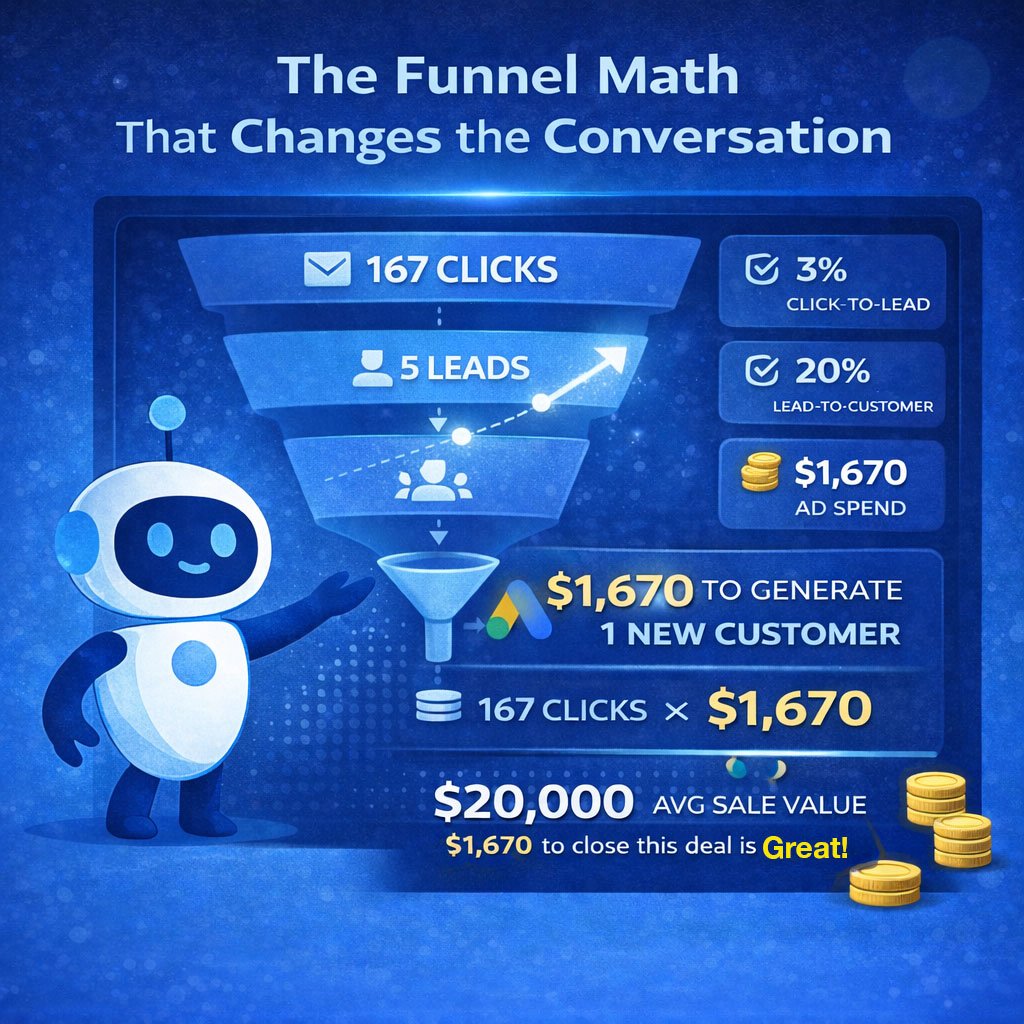
A typical B2B funnel benchmark looks like this: the click-to-lead conversion rate sits between 2 and 5%. Lead-to-customer conversion sits between ten and thirty percent (if you’re managing your Google Ads campaign right).
Using conservative numbers, you can expect three percent of your clicks to become leads, and twenty percent of those leads to become paid customers.
That means you need roughly 167 clicks to generate one new customer. That’s why using Google Keyword Planner to get the cost of the average click in your industry is so crucial.
Once clients see this number (167 clicks × the current per-click rate for your core keywords), daily budgets start to look very different.
If your clicks cost ten dollars, you need roughly $1,670 in ad spend to generate one customer, but if your average deal value is $20,000, $1,670 to close this deal is a great investment. But if your average deal value is only five hundred dollars, the math does not work if your average cost per click is closer to ten dollars. However, it would work if your cost per click is one dollar or less.
This is why daily budgets are the wrong starting point. Cost-per-click economics must come first. That’s why Google Keyword Planner should be your first stop.
What A Twenty Dollars Per Day Google Ads Budget Actually Buys
Let’s imagine a typical U.S.-Based SaaS Google Ads campaign with an average CPC of around $10.
Your twenty-dollar daily budget would then only buy you two clicks per day. That becomes sixty clicks per month. With a three percent conversion rate, you could, in theory, generate roughly two leads per month. With a twenty percent close rate, you generate one new customer every two or three months. But this is a false equivalence because you simply aren’t generating enough clicks and conversions to inform Google’s algorithm (remember, that’s a 30-conversion-per-month minimum?).
Google Ads needs data to optimize. It needs conversions because the platform performs best when campaigns reach roughly thirty conversions per month. Below that threshold, optimization becomes unstable. Smart bidding cannot fully learn, and A/B testing becomes painfully slow.
The lack of data in this case is due to the budget being too low to generate meaningful results.
How To Use Google Keyword Planner to Calculate Realistic Budgets
So how do you figure out the right daily budget?
You must start with the cost per click for your core high-intent keywords. Not with guesswork. Not with comfort numbers. With real auction data.
Google Keyword Planner is the source of truth. SpyFu is a useful supplement for competitor research and keyword expansion, but Keyword Planner provides the actual CPC data you need directly from Google.
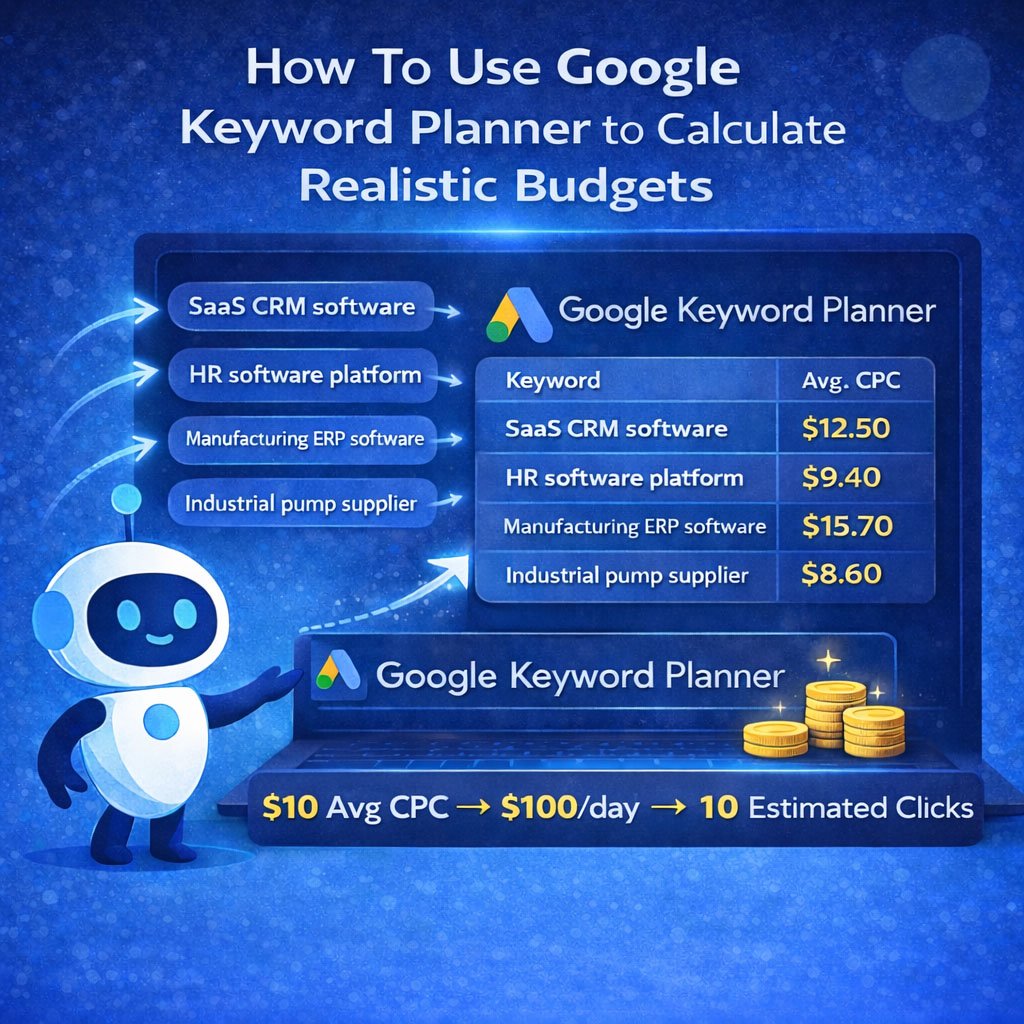
Start with your core keywords. These are the main product or service terms your buyers use. For example: “SaaS CRM software,” “HR software platform,” “Manufacturing ERP software,” or “Industrial pump supplier.”
Upload your core keywords into Keyword Planner and set the targeting to the correct country and time range. Then look at Top of Page Bid (high range). This column reflects the real competition in the auction.
If the average CPC comes back at ten dollars, you immediately know that a twenty-dollar daily budget will only buy two clicks. If the CPC comes back at fifty cents, you know that twenty dollars buys forty clicks, and you have much more room to experiment.
Budget must follow CPC, not the other way around.
Why Optimizing for Daily Budgets Is the Wrong Strategy
Once budgets are set, many teams keep returning to the same question: Should we increase or decrease the daily budget?
This is the wrong question.
The right question is: how much does it cost us to acquire a new customer?
The Metrics That Actually Matter: CPL and CAC
Cost per lead is the first real performance metric.
CPL equals CPC divided by conversion rate. If your CPC is $10 and your conversion rate is 3%, your cost per lead is approximately $333.
Customer acquisition cost goes one step further. CAC equals CPL divided by close rate. If 20% of leads become customers, your CAC is roughly $1,667.
Now the real question appears: what is one customer worth?
If your average SaaS contract is $15,000 per year, this campaign is incredibly profitable. If your contract value is $1,000, you need to improve your conversion rate or rethink your strategy.
This is the conversation B2B teams should be having. Not a daily budget. Economics.
Estimating ROAS for B2B Campaigns
How do you estimate your return on ad spend for your Google Ads B2B campaigns? Simple, multiply the number of leads by the close percentage rate and the average deal value, then divide by ad spend.
For example, if you spend three thousand dollars per month on Google Ads to generate thirty leads and close twenty percent of them, and your average deal is ten thousand dollars, your revenue is sixty thousand dollars. Your ROAS is twenty times.
This is how you demonstrate value to stakeholders.
Weekly Google Ads Optimization Toward Lowering Your CAC
Once campaigns are live, the goal is to reduce CPL and CAC over time. Weekly optimization must focus on improving conversion rates, refining keywords, testing new ads, and expanding high-performing audiences. Over time, CPL and CAC decrease while lead volume increases.
Daily budget becomes a background setting. CAC economics becomes the focus.
Why Marketing Automation Is the Secret Sauce in B2B PPC
This is where HubSpot marketing automation changes the PPC B2B game.
Google Ads is exceptional at generating B2B leads, and HubSpot is exceptional at turning those leads into paying customers through marketing automation.
When HubSpot is integrated with your Google Ads campaigns, conversion values can be sent back to Google. This enables Google’s algorithms to optimize for qualified leads who are more likely to close deals, rather than tire kickers.
Marketing automation turns raw leads into a qualified pipeline, shortens sales cycles, and improves close rates, which lowers your CAC.
The Google Ads Budget Question Reframed
Instead of asking whether twenty dollars per day is enough to run Google Ads, the better question is: what is the cost to acquire a customer, and is it profitable?
Google Ads is not a traffic expense. It is a pipeline investment when done right.
When these pieces come together, Google Ads becomes predictable, scalable, and profitable.
If you want help building a Google Ads and HubSpot engine that focuses on pipeline and revenue instead of daily budgets, the experts at WhaleClicks are ready to help.